

Have you ever wondered how cleanrooms maintain their ultra-clean environments, even with people and materials constantly moving in and out? The secret lies in airlocks! The cleanroom terminology can be challenging at times, but to simplify it, airlocks act as a protective barrier. These specialized entryways prevent unwanted contaminants from sneaking inside by controlling pressure and the flow of air and people.
Airlocks ensure only 1 door opens at a time, creating a shielded space that keeps dirt, dust, and particles at bay. Whether you’re an industry expert or just curious about the purpose of airlocks, understanding how airlocks work is key to maintaining pristine spaces.
Cleanrooms require meticulous care to maintain their integrity, especially when it comes to controlling the higher pressure and particle contamination. Airlocks play a vital role in preventing contaminants from entering when personnel or materials move in and out.
Air locks serve as a controlled buffer zone, ensuring only 1 door opens at a time to prevent the direct exchange of air between cleanroom zones and external areas. This controlled transition minimizes contamination risks by reducing the influx of particles and microorganisms.
Here’s an easy-to-understand guide to airlocks, including their purpose, types, and key features.
Air locks act as entry and exit barriers to cleanrooms, minimizing particle transfer. The idea is simple—when people or materials enter or exit a cleanroom, airlocks ensure that the process does not compromise the controlled environment inside.
Only one door is opened at a time, which prevents a direct flow of air (and contaminants) into the cleanroom. Many airlocks use High-Efficiency Particulate Air (HEPA) filters to further purify air within the enclosed space.
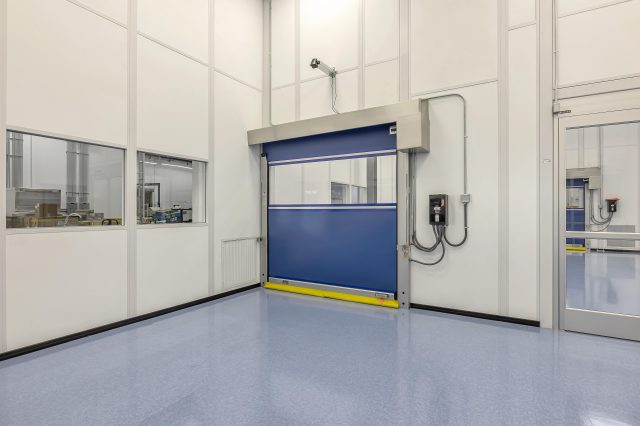
PALs are, commonly known as gowning rooms, are critical for maintaining cleanroom integrity. They serve as a designated space where personnel don cleanroom garments and undergo contamination control procedures before entry.
They also act as a buffer to reduce the introduction of particles when personnel move between the cleanroom and the external environment. These airlocks often include features like interlocked airlock doors that prevent both airlock doors from being opened simultaneously.
Material airlocks control the movement of goods and materials into and out of cleanrooms. Larger versions may use interlocked motorized roll-up doors, while smaller versions may use less costly swing doors.
Material airlocks (MALs) often incorporate HEPA or ULPA filtration systems to ensure the cleanliness of incoming and outgoing materials. The design and filtration level depend on the cleanroom’s ISO classification and specific industry requirements.
Pass-through chambers are compact airlocks designed to facilitate the transfer of materials without compromising cleanroom integrity. These systems often include mechanical or electronic interlocks and, in some cases, HEPA filtration to ensure higher pressure and particle control during transfers.
A study by Sun, Flyzik, Mitchel, and Watave (2011) revealed that a single door could stop up to 80% of particle transfer. When a two-door airlock system is employed, particle transfer is reduced by as much as 96%. Incorporating HEPA filtration within the airlock system can further enhance its effectiveness, achieving even greater levels of particle containment.

Interlocks prevent both doors of an airlock from being opened at the same time, creating a secure buffer zone. Electronic interlocks often use magnetic locks, sensors, and programmable logic controllers (PLCs) for precise control.
Mechanical interlocks, on the other hand, often used in compact systems like pass-through chambers, ensure only one door can be opened at a time. These systems are cost-effective and reliable but may lack the advanced automation offered by electronic interlocks.
Cleanrooms often use positive pressure to keep contaminants out. In this system, the cleanroom’s have a higher pressure than the airlock’s, so air flows outward when the door opens.
Positive pressure systems create an air pressure gradient, often called a “pressure cascade,” that ensures air flows from cleaner areas to less clean zones. This controlled airflow significantly reduces the risk of particle infiltration into the cleanroom.
Gowning rooms, often integrated as part of personnel airlocks, provide a controlled area for donning cleanroom-approved garments. These rooms are equipped with anti-static benches, tacky mats, and sometimes mirrors to ensure compliance with gowning protocols.

Cleanroom and gown room airlocks are essential for preserving the clean, controlled environment within a cleanroom by blocking contaminants at every entry and exit point. From personnel airlocks to pass-through chambers and integrated air showers, each type of airlock contributes uniquely to maintaining the cleanroom’s air quality and preventing cross contamination.
Whether managing a commercial facility or simply exploring how these systems work, understanding cleanroom airlocks can help you make informed decisions about maintaining a cleanroom environment.
When it’s time to set up or upgrade a cleanroom, consider working with professionals like Modulus Cleanrooms to ensure the highest quality standards and effective contamination control solutions.
Our team is here to help with all your modular cleanroom questions.