
Cleanrooms are specialized environments designed to control airborne particles, temperature, humidity, and pressure to protect sensitive processes and products. They are essential in industries like biotechnology, aerospace, and semiconductor manufacturing, where even a microscopic contaminant can compromise results or safety.
One of the most overlooked but critical factors in cleanroom performance is its size. The dimensions of a cleanroom directly influence workflow efficiency, operational cost, and contamination control.
This article from Modulus Cleanrooms explores how cleanroom size affects process flow, from design and materials to cost and construction, helping decision-makers plan spaces that balance precision, productivity, and flexibility.
Cleanrooms vary widely in scale and classification. They fall into four categories:

Cleanroom size not only determines usable space but also affects layout flexibility, personnel management, and system performance. Choosing the right size ensures that operations remain scalable and compliant with cleanliness standards.
The development of a cleanroom follows several major phases: planning, design, construction, and validation. Each phase’s duration and complexity depend heavily on the cleanroom size.
For smaller cleanrooms, the planning stage may take only a few weeks. Designers can focus on space efficiency and airflow design within a compact area.
Larger or multi-room projects, however, require months of coordination between engineering, quality assurance, and regulatory teams to ensure all systems align with industry standards such as ISO 14644.
During construction, small cleanrooms can be installed quickly, especially if modular panels are used. Larger facilities, on the other hand, demand extensive mechanical, electrical, and HVAC work. The timeline lengthens further when integrating advanced filtration, pressure zoning, or automated systems.
Validation and certification are also size-dependent. Larger cleanrooms have more zones to test, more filters to qualify, and longer commissioning processes. The project’s overall timeline may double compared to smaller builds.
Materials define a cleanroom’s durability and hygiene performance. Common options include stainless steel, powder-coated aluminum, PVC, and vinyl finishes that resist chemical corrosion and prevent particle buildup.
Cleanroom size plays a significant role in resource selection and allocation. A compact room might require only a few wall panels, HEPA filters, and light fixtures, while a large or mega cleanroom may need thousands of components and extensive HVAC ductwork. The complexity grows as more utilities (e.g., gas lines, data cabling, and automation systems) are integrated.
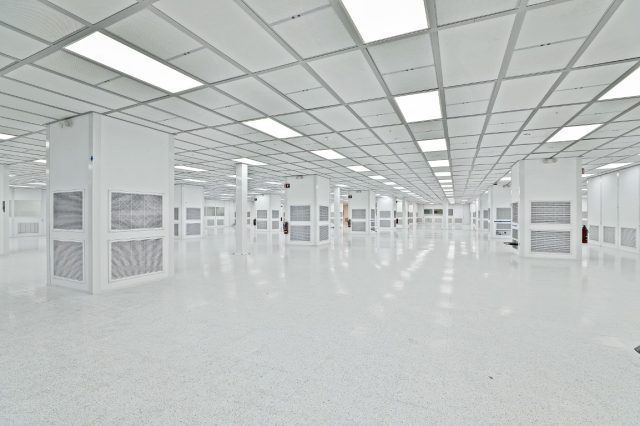
For large-scale facilities, material procurement and logistics have become key considerations. Coordinating suppliers, ensuring material uniformity, and maintaining delivery timelines require precise planning. Quality control is also vital; even small inconsistencies in materials can lead to airflow disruptions or contamination risks.
Cost is often the most visible factor affected by cleanroom size. The initial construction expense scales with square footage, but so do long-term operational costs like energy use, maintenance, and staffing.
Smaller cleanrooms are typically more cost-efficient upfront. They require fewer materials and less powerful HVAC systems. However, their limited size may restrict workflow flexibility or expansion options later.
Larger cleanrooms involve greater upfront investment, driven by increased materials, engineering hours, and system capacity. Yet they can offer economies of scale. When designed efficiently, a larger facility may reduce per-unit production costs or streamline multiple processes within a single environment.
To manage costs effectively, Modulus Cleanrooms recommends an integrated approach:
Balancing size with operational needs ensures that a cleanroom investment supports both performance and profitability.
Cleanroom construction is a multidisciplinary effort requiring skilled project team partners, from architects and engineers to HVAC technicians and certification specialists. Selecting the right team is especially important for large-scale projects, where coordination directly impacts process flow and final compliance.

For example, smaller cleanrooms may rely on a compact team with overlapping roles, while mega cleanrooms demand multiple specialized subcontractors and detailed project management to synchronize complex systems.
Filtration systems are the backbone of cleanroom performance. HEPA and ULPA filters maintain air cleanliness by removing microscopic particles from circulation. The size of the cleanroom influences both the number and configuration of filters required.
Smaller cleanrooms often use ceiling-mounted HEPA units or fan-filter modules that handle modest airflow volumes. Larger or multi-zone cleanrooms need extensive filtration grids, pressurized plenums, and air recirculation loops to maintain consistent ISO classifications throughout the space.
Effective filtration also depends on maintenance and monitoring. Larger facilities require dedicated monitoring systems to track air quality, pressure differentials, and filter integrity. Regular replacement schedules and strategic placement of filters ensure that every section maintains compliance.
Airflow design determines how clean air moves through the environment and carries away contaminants. Two main airflow patterns, laminar and turbulent, are used depending on the process. Laminar flow provides uniform air movement, ideal for precision manufacturing, while turbulent flow offers cost-effective cleanliness for less critical zones.
Cleanroom size plays a key role in determining HVAC capacity and pressure zoning. Larger cleanrooms need more powerful air handlers and multiple zones to balance air pressure between clean and less-clean areas. Improper design can cause pressure imbalances that lead to contamination risks or inefficiencies.
Cleanroom size affects every part of the process flow, from planning and cost to airflow and contamination control. A well-sized cleanroom enhances productivity, compliance, and long-term scalability. When planning your next project, consider how dimensions, systems, and workflow will interact. The right balance between space and efficiency ensures consistent performance and smooth operation.
Modulus Cleanrooms specializes in designing, building, and certifying cleanrooms that match your operational needs. Our expert team delivers precision-engineered environments built for performance and compliance. Contact us today to begin designing a cleanroom that optimizes process flow, efficiency, and innovation.