
ISO classifications are a vital component of modular cleanroom design and construction. These classifications measure the number of particles present in a given space. The standards for cleanrooms are internationally recognized by the Cleanrooms and Associates Controlled Environments. Our specialty lies in ISO class 5 through 8 cleanrooms. These classifications are essential for the design, installation, and construction of modular cleanrooms.


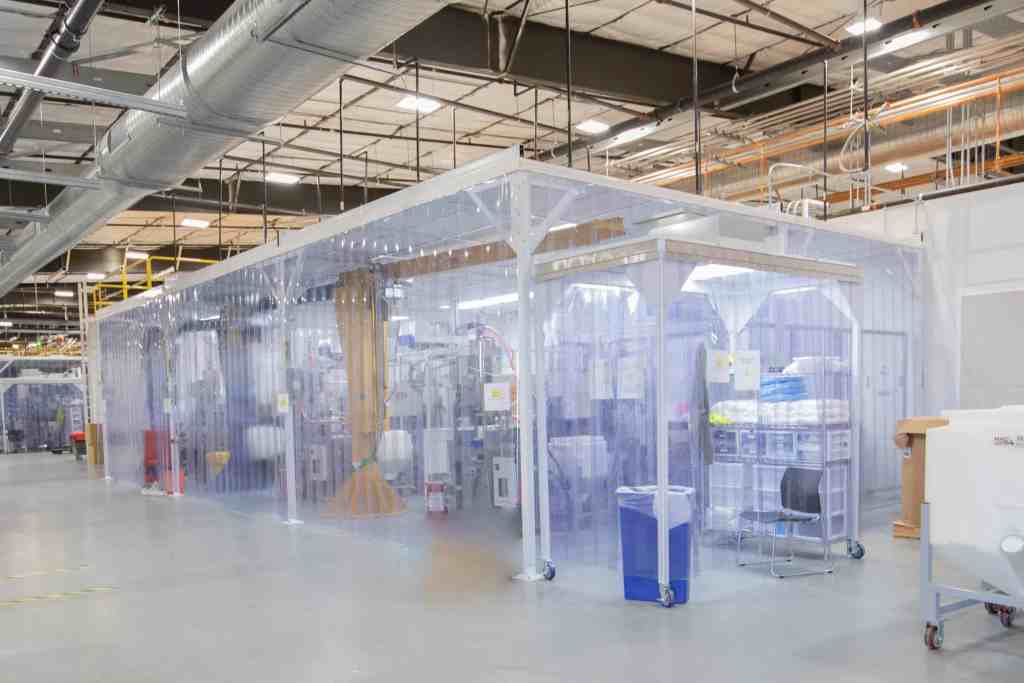

Cleanrooms can be designed using either hardwall or softwall construction methods, depending on the specific requirements and applications, and budget, Modulus will guide you through what needs to be considered for a specific application, such as the ISO classification, airflow and air change per hour requirements, filtration, particle control, and gowning. Compared to conventional cleanroom construction, a modular cleanroom is easier to assemble or modify.
Structure: Hardwall cleanrooms have rigid walls and ceilings constructed from durable materials.
Containment: Hardwall cleanrooms offer a high level of containment and control due to the nature of the walls and ceilings.
Customization: Hardwall cleanrooms allow for more customization options in terms of size, layout, and integration of equipment. They can accommodate all ISO requirements.
Structure: Softwall cleanrooms feature flexible walls made from materials like vinyl or PVC curtains.
Containment: Softwall cleanrooms offer a lower level of control compared to hardwall cleanrooms. Softwall cleanrooms can be assembled dis-assemble for relocation.
Customization: Modulus hardwall cleanrooms allow for more customization options in terms of size, layout, and integration of equipment. They can accommodate ISO 5-8 class ranges.
Cleanrooms are classified by the number and size of particles found in a cubic meter of air. They are classified under ISO 14644-5:2004 and Federal Standard 209E.
| CLASS NAME | MAXIMUM PARTICLE SIZES | ||||||
|---|---|---|---|---|---|---|---|
| ISO | FED STD 209E | 0.1 micron | 0.2 microns | 0.3 microns | 0.5 microns | 1 micron | 5 microns |
| ISO 1 | - | 10 | 2 | 1 | 0.35 | 0.083 | 0.0029 |
| ISO 2 | - | 100 | 24 | 10 | 3.5 | 0.83 | 0.029 |
| ISO 3 | 1 | 1,000 | 237 | 102 | 35 | 8.3 | 0.29 |
| ISO 4 | 10 | 10,000 | 2,370 | 1,020 | 352 | 83 | 2.9 |
| ISO 5 | 100 | 100,000 | 23,700 | 10,200 | 3,520 | 832 | 29 |
| ISO 6 | 1,000 | 1,000,000 | 237,000 | 102,000 | 35,200 | 8,320 | 293 |
| ISO 7 | 10,000 | 10,000,000 | 2,370,000 | 1,020,000 | 352,000 | 83,200 | 2,930 |
| ISO 8 | 100,000 | 100,000,000 | 23,700,000 | 10,200,000 | 3,520,000 | 832,000 | 29,300 |
| ISO 9 | - | 1,000,000,000 | 237,000,000 | 102,000,000 | 35,200,000 | 8,320,000 | 293,000 |
*This table relates to cleanliness class to both the average air velocity in the cleanroom and rate of air changes per hour. The range of values listed is a consensus of existing practice and is not intended to indicate design. It is up to the designer and end user to arrive at a value either inside or outside the range that is consistent with project needs. Generally the approach is to the higher values in cleanrooms housing a relatively dirty process or where the cleanroom garment program or discipline is relaxed. The lower end of the range is more appropriate for cleaner processes and a more disciplined cleanroom gowning procedure.
| Cleanliness Classification | Airflow Pattern | Average Air Velocity | Air Changes Per Hour |
|---|---|---|---|
| ISO Class 8 (100,000) | Nonunidirectional/Mixed | 1-8 fpm | 5-30 |
| ISO Class 7 (10,000) | Nonunidirectional/Mixed | 10-15 fpm | 30-70 |
| ISO Class 6 (1,000) | Nonunidirectional/Mixed | 25-40 fpm | 125-240 |
| ISO Class 5 (100) | Unidirectional | 40-80 fpm | 240-480 |
| ISO Class 4 (10) | Unidirectional | 50-90 fpm | 300-540 |
| ISO Class 3 (1) | Unidirectional | 60-90 fpm | 360-540 |
| ISO Class 2 | Unidirectional | 60-100 fpm | 360-600 |
*This table relates to cleanliness class to both the average air velocity in the cleanroom and rate of air changes per hour. The range of values listed is a consensus of existing practice and is not intended to indicate design. It is up to the designer and end user to arrive at a value either inside or outside the range that is consistent with project needs. Generally the approach is to the higher values in cleanrooms housing a relatively dirty process or where the cleanroom garment program or discipline is relaxed. The lower end of the range is more appropriate for cleaner processes and a more disciplined cleanroom gowning procedure.
* Ideal differential pressurization range: (“w.g.”) 0.02-0.08
| Cleanliness Class | Filter Efficiency | Ceiling Grid Type | Air Return Design | Filtered Ceiling Coverage |
|---|---|---|---|---|
| ISO Class 2 | 99.99999% @ 0.12µm | Gel Grid | Raised Floor | 100% Ceiling Coverage |
| ISO Class 3 | 99.9995% @ 0.12µm | Gel Grid | Raised Floor | 100% Ceiling Coverage |
| ISO Class 4 | 99.999% @ 0.12µm | Gel Grid | Raised Floor | 100% Ceiling Coverage |
| ISO Class 5 | 99.99% @ 0.30µm | 1-1/2" T Bar Gasket | Low Wall | 50-100% Ceiling Coverage |
| ISO Class 6 | 99.99% @ 0.30µm | 1-1/2" T Bar Gasket | Low Wall | 20-60% Ceiling Coverage |
| ISO Class 7 | 99.99% @ 0.30µm | 1-1/2" T Bar Gasket | Low Wall | 5-40% Ceiling Coverage |
| ISO Class 8 | 99.99% @ 0.30µm | T Bar Grid | Low Wall or Ceiling | 5% Ceiling Coverage |
Our team is here to help with all your modular cleanroom questions.