
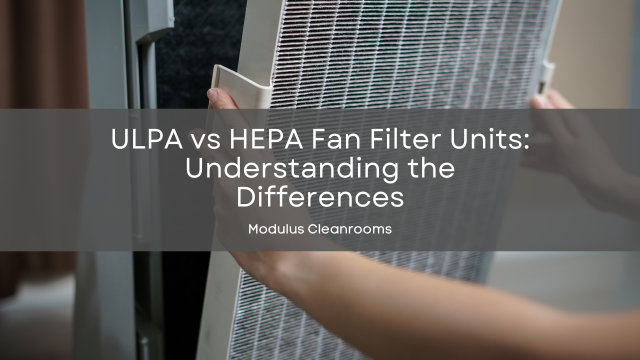
Choosing the right filtration system is one of the most important decisions when designing a cleanroom, and Modulus Cleanrooms has seen firsthand how critical this choice is for companies in California’s biotechnology, semiconductor, aerospace, and advanced manufacturing sectors.
The level of air purity directly affects product quality, regulatory compliance, and operational efficiency.
A fan filter unit, often called an FFU, is a self-contained unit that draws in air, pushes it through a high-efficiency filter, and delivers purified air into the cleanroom. These units typically sit in the ceiling grid of modular cleanrooms and operate continuously to maintain controlled particle levels.
The main distinction between FFUs lies in the filter used. These filters are either HEPA or ULPA, and each comes with its own performance characteristics, efficiency levels, and airflow behavior.
Both HEPA and ULPA filters are effective. The key is selecting what your process truly requires.
Although they serve the same purpose, HEPA and ULPA filters are very different in terms of structure, filtration performance, airflow resistance, and impact on cleanroom operations. Understanding these differences helps determine which system is the right fit.

The most significant difference is filtration capability. HEPA filters remove extremely small particles, but ULPA filters push that performance even further by capturing a higher percentage of smaller particles. The gap may look small on paper, yet in a cleanroom environment, it can affect contamination control, yield rates, and product stability.
ULPA’s finer filtration makes it the superior choice for processes that involve sensitive microstructures or particle-sensitive manufacturing. For most biotech, medical device, and pharmaceutical cleanrooms, HEPA filtration is more than sufficient and provides excellent performance without unnecessary cost.
ULPA filters have a denser fibre structure than HEPA filters, which increases resistance to airflow. This means the fan inside the FFU must work harder to push air through the filter. Higher resistance results in higher energy consumption and may require more powerful FFUs to achieve the same air change rate as a HEPA system.
In some cases, using ULPA filters without accounting for the added resistance may lead to insufficient airflow, reduced air changes per hour, turbulence, or dead zones. When ULPA is truly required, the cleanroom airflow plan must be adjusted accordingly. HEPA filters, by contrast, allow more air to pass through with lower resistance, which helps maintain strong airflow and efficient circulation throughout the cleanroom.
Your required ISO classification plays a major role in determining which filtration system fits your needs. ISO 5 to ISO 8 cleanrooms typically use HEPA filters because they provide the required particle control without excessive energy consumption or maintenance demands.

ISO 3 and ISO 4 spaces often require ULPA filtration because these cleanroom classes require extremely low particle counts. ULPA’s finer filtration helps maintain these ultra-clean conditions more reliably. Most California cleanroom projects fall within ISO 5 to ISO 8 levels unless the facility is operating in semiconductor, aerospace, microfabrication, or nanotechnology sectors.
Since ULPA filters have finer fibres and trap smaller particles, they tend to load faster. This can reduce their lifespan compared to HEPA filters. ULPA filters also require more frequent integrity testing and often demand a higher level of maintenance oversight.
HEPA filters are more forgiving. They are easier to maintain, typically last longer, and can be monitored with simple pressure-drop measurements. In an energy-conscious environment, maintaining efficiency and reducing downtime is essential. This often makes HEPA systems the more practical choice unless ULPA is truly required.
ULPA systems cost more, both in upfront investment and operational expenses. They require more energy, can shorten FFU lifespan, and may lead to more frequent filter replacement. Meanwhile, HEPA filters offer excellent performance at a lower cost and with fewer energy demands. Over the life of the cleanroom, this can lead to significant savings, which is an important consideration for California-based operations managing high utility costs.
Selecting the right FFU begins with understanding your process, level of risk, and regulatory needs.
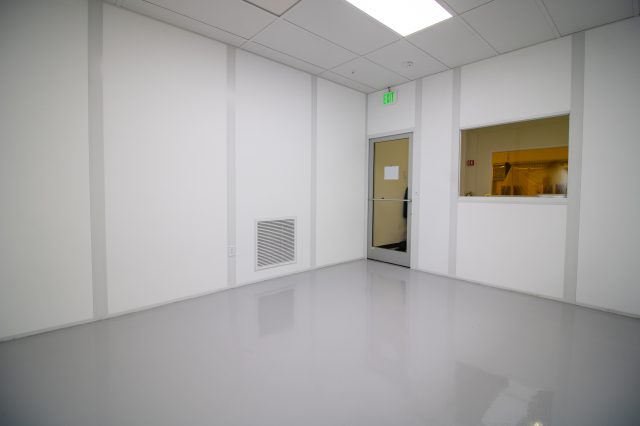
Regardless of which filtration system you choose, proper implementation is essential to maintain cleanroom performance. Follow these tips:
Choosing between ULPA and HEPA fan filter units is not simply about selecting the most advanced filter. It is about choosing the filter that aligns with your cleanroom’s purpose, regulatory requirements, operational costs, and production risks. HEPA filters meet the needs of most California biotech, medical device, and advanced manufacturing cleanrooms.
ULPA filters are ideal for ultra-critical industries requiring the highest level of particle control. With the right guidance and a clear understanding of the differences, you can build a cleanroom that performs reliably and supports your operations for years to come.
Ready to build or upgrade a cleanroom? Modulus Cleanrooms designs and constructs high-performance modular cleanrooms tailored to your filtration, airflow, and regulatory needs. Connect with our team to discuss your project and find the right HEPA or ULPA solution for your facility.